

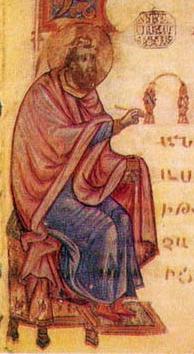
David the Invincible
Greek · Philosophy · Ethics
2 works · 10,622 aligned sentences
Commentary on Porphyry's Isagoge
This work is a detailed lecture-style commentary by the late antique philosopher David Anhaght on Porphyry's *Isagoge*, the classical introduction to Aristotelian logic. David begins by elucidating the purpose and utility of the text, examining dialectical methods, the sequence of the five universal concepts (predicables), and the ontological status of universals versus particulars. In the main body, he systematically investigates the five universals—genus, species, differentia, property, and accident—analyzing their definitions, disambiguating multiple senses, and tracing the hierarchical order from highest genera to lowest species and individuals. Throughout this analysis, he contrasts Platonic and Aristotelian doctrines while resolving logical aporias and objections through rigorous textual exposition. The latter part of the commentary is devoted to an exhaustive comparison of the mutual commonalities and differences among the five universals, employing combinatorial calculation to demarcate their logical boundaries. The work systematically articulates the conceptual foundations of logical reasoning and ontological classification within the pedagogical framework of late antiquity.
Philosophy51 chunks · §96.29-98.15–§219.5-219.255,471 aligned sentencesRead →Prolegomena to Philosophy
Attributed to the late antique philosopher David the Invincible (David Anhaght), this work is an introductory pedagogical treatise that systematically examines the scope of philosophy according to the Aristotelian fourfold framework of inquiry: its existence, essence, quality, and purpose. The lecture opens with a defense of philosophy's existence against skeptical and Pyrrhonian objections, demonstrating that immutable universals are indeed knowable. David then establishes the logical foundations of definition and analyzes the six traditional definitions of philosophy inherited from Pythagoras, Plato, and Aristotle, harmonizing their differing perspectives through ontology, teleology, and numerical symbolism. Next, through the method of division (diairesis), the text classifies philosophy into theoretical and practical branches, elaborating on the threefold division of theoretical philosophy (physics, mathematics, and theology), the mathematical quadrivium, and the civic sciences of ethics, economics, and politics. Ultimately, the treatise concludes by uniting these definitions and divisions, affirming that philosophy's highest purpose is to order the cognitive and vital faculties of the soul, thereby leading human beings toward virtue and assimilation to the divine.
Philosophy57 chunks · §1.4-2.29–§78.15-79.295,151 aligned sentencesRead →