

John Philoponus
Greek · Philosophy · Commentary · Ethics
8 works · 209,662 aligned sentences
Birth: c. 490 AD / Death: c. 570 AD
Alexandria · philosopher · theologian · mathematician
Commentary on Aristotle's Categories
This commentary by John Philoponus is a systematic, lemmatized exposition of Aristotle's Categories, originating from the lecture tradition of the late antique Alexandrian school. The work begins with extensive introductory questions (prolegomena) concerning the study of Aristotelian philosophy as a whole and defines the subject of the Categories as simple expressions signifying simple things through simple concepts. Following the traditional tripartite structure of the treatise, it proceeds from preliminary distinctions—such as homonyms, synonyms, paronyms, and the fourfold division of beings—to an in-depth examination of the primary categories, especially substance, quantity, relatives, and quality, addressing various traditional problems (aporiai) and identifying their distinctive properties. Philoponus then briefly defines the remaining six categories before thoroughly analyzing the post-predicaments, which include the four modes of opposition, the notions of priority and simultaneity, as well as the varieties of motion and the meanings of "having." While rooted in the Neoplatonic philosophical framework, the commentary critically integrates perspectives from natural philosophy and ordinary language, providing a comprehensive guide to foundational Aristotelian logic.
Philosophy127 chunks · §1.2-1.18–§204.23-205.2811,248 aligned sentencesRead →Commentary on Aristotle's Generation of Animals
This work is a detailed scientific and philosophical commentary by John Philoponus on Aristotle's treatise *Generation of Animals*. Taking the text as the purposeful continuation of *Parts of Animals*, the commentator identifies the efficient causes of generation and the teleological design of reproductive organs as the central scope of the work. Philoponus begins by establishing the core Aristotelian principle that male semen provides the formal and efficient impulse while female menses supplies the passive material, refuting competing theories such as pangenesis. He proceeds to trace the sequence of embryonic development initiated by the heart, the diverse modes of reproduction across viviparous, oviparous, and spontaneously generated animals, and the physiological mechanisms governing sex determination, hereditary resemblance, and congenital deformities. In the final section, the commentary explains accidental individual traits—such as eye color, hair texture, and vocal pitch—through material necessity and efficient causation, concluding with a critique of natural philosophers like Democritus who neglected the essential role of the final cause.
Philosophy185 chunks · §1.3-2.31–§247.27-249.1814,863 aligned sentencesRead →Commentary on Aristotle's Meteorology, Book 1
This work is a philosophical and scientific commentary by the late-antique thinker John Philoponus on Book 1 of Aristotle's Meteorology. Proceeding lemma by lemma, Philoponus rigorously evaluates Aristotle's text through the lenses of astronomy, optics, and geometry, frequently offering acute criticisms of Aristotle himself as well as earlier commentators like Alexander of Aphrodisias. The commentary begins by establishing the place of meteorology within the system of natural philosophy, examining the structure of the cosmos, the interaction of the celestial realm with the sublunary elements, and the mechanism by which the sun heats the lower air. Philoponus then analyzes how two types of exhalation—moist vapor and dry smoky breath—give rise in the upper reaches of the sublunary sphere to shooting stars, fiery apparitions, and optical impressions. The investigation subsequently addresses comets and the Milky Way; while reviewing and refuting earlier theories, Philoponus notably breaks with Aristotle by arguing, on the basis of astronomical permanence and lack of parallax, that the Milky Way is not a sublunary combustion but an enduring celestial phenomenon. Finally, the focus turns to the middle and lower atmospheric regions, where Philoponus explores the cycle of evaporation and condensation, invoking the dynamic principle of antiperistasis (mutual repulsion and concentration of heat and cold) to explain the formation of rain, snow, and hail.
Philosophy104 chunks · §1.4-2.20–§129.22-131.128,180 aligned sentencesRead →Commentary on Aristotle's On Generation and Corruption
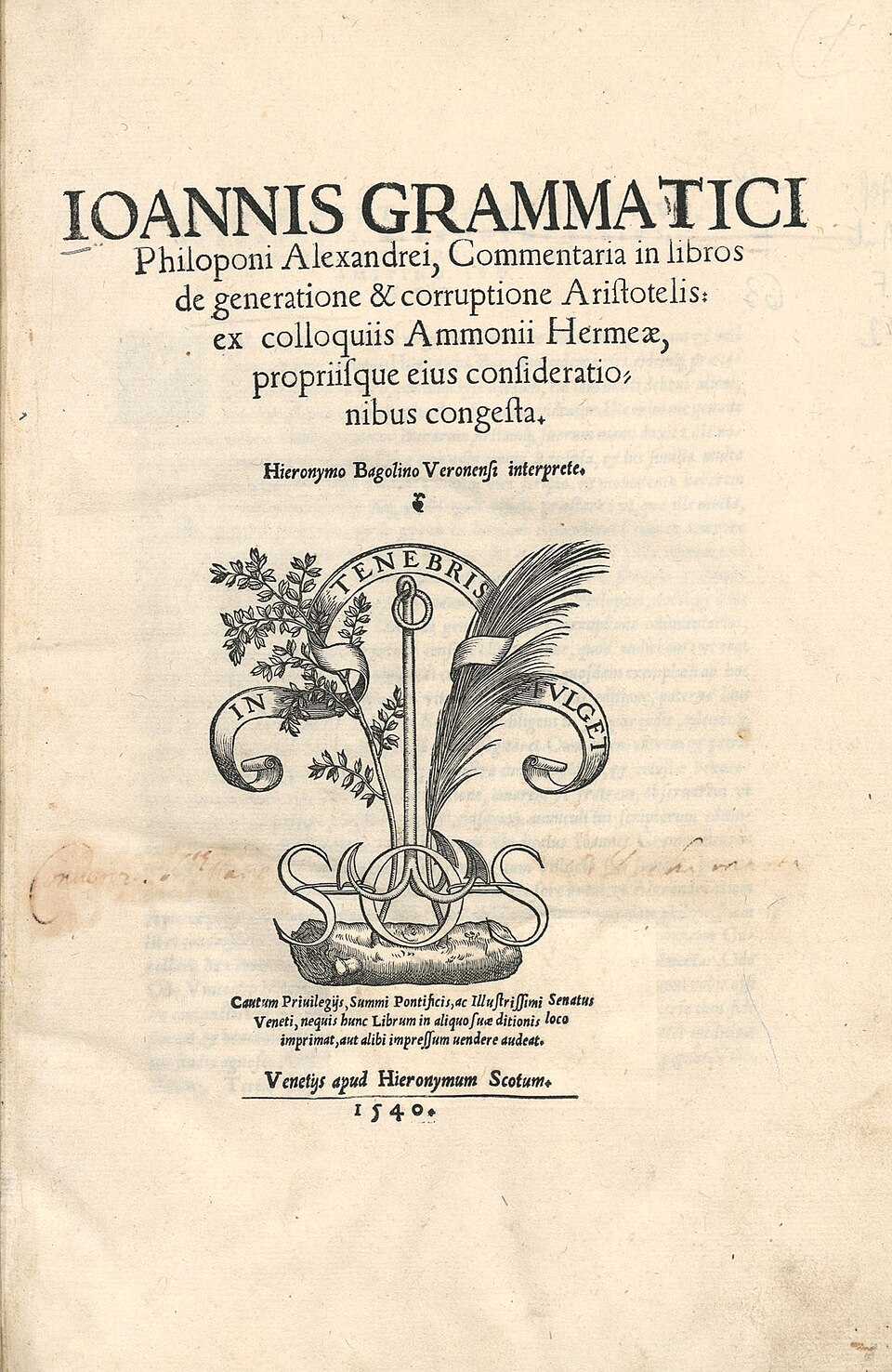
This work is a detailed commentary by the sixth-century Alexandrian philosopher John Philoponus on Aristotle's physical treatise On Coming-to-Be and Passing-Away (De generatione et corruptione). After situating the treatise within Aristotle’s broader natural philosophy, the first part rigorously distinguishes unqualified generation and destruction from alteration and growth, offering an extensive critique of early theories such as atomism and Platonic surfaces while clarifying the foundational concepts of contact, action, passion, and mixture. The second part investigates the four sublunary elements, defining them through primary tactile contrarieties (hot, cold, dry, and moist) and demonstrating how their mutual transformation yields various composite bodies. The inquiry then turns to the efficient and final causes of perpetual coming-to-be, identifying the celestial revolutions—especially the sun's motion along the ecliptic—as the primary cosmic driver. The commentary concludes with an examination of necessity and circularity in generation, illustrating how perishable particulars mirror eternity through the cyclical continuation of their species.
Philosophy207 chunks · §1.5-2.33–§313.1-314.2218,934 aligned sentencesRead →Commentary on Aristotle's On the Soul
This work is a comprehensive commentary on Aristotle's *De Anima* (*On the Soul*) by the late antique Alexandrian philosopher John Philoponus. Proceeding through structured lectures comprising theoretical discussions (*theoria*) and detailed textual analyses (*lexis*), it systematically investigates the nature and faculties of the soul (*psyche*), ranging from vegetative life to rational intellect. The commentary on Book 1 critically re-examines the views of earlier natural philosophers who reduced the soul to motion, elements, or bodily harmony, thereby demonstrating the soul's incorporeal nature. In Book 2, Philoponus examines Aristotle's definition of the soul as the first entelechy (actuality) of an organic natural body, elaborating on the vegetative functions of nutrition and reproduction, as well as the physiological and formal mechanisms of the five senses and their media. Book 3 explores higher cognitive faculties, including the common sense, imagination (*phantasia*), and the nature of the intellect (*nous*), culminating in an analysis of the appetitive faculty that governs animal locomotion and the teleological role of sensation in sustaining life. Throughout the work, Philoponus vigorously debates earlier commentators like Alexander of Aphrodisias to uphold the immortality, immateriality, and distinct autonomy of the human rational soul.
Philosophy451 chunks · §1.5-3.11–§606.3-607.2245,460 aligned sentencesRead →Commentary on Aristotle's Physics
This work is John Philoponus's commentary on the eight books of Aristotle's Physics, offering a systematic investigation into the fundamental principles of natural things and the structure of motion. Through meticulous textual analysis of individual lemmata, the author rigorously reconstructs Aristotle's arguments from the critique of earlier thinkers to his own theoretical conclusions. The opening sections establish the three principles of change—matter, form, and privation—alongside the definition of nature, the four causes, and teleology. In the middle books, the inquiry proceeds from the definition of motion to an examination of the infinite, place, void, and time, wherein Philoponus critically reassesses Aristotelian doctrine by proposing place as a three-dimensional extension and analyzing projectile motion. The latter books address the continuity of magnitudes, the impossibility of indivisibles, and the refutation of Zeno's paradoxes, culminating in the demonstration of the primary unmoved mover and the primacy of celestial circular motion. It provides readers with a rigorous exposition of classical natural philosophy while presenting an incisive internal critique from late antiquity.
Philosophy567 chunks · §1.3-2.13–§907.1-908.2150,565 aligned sentencesRead →Commentary on Aristotle's Posterior Analytics
This work is a comprehensive philosophical commentary by the late antique philosopher John Philoponus on Aristotle's *Posterior Analytics*, the foundational text of Aristotelian logic and epistemology. Philoponus frames scientific demonstration as the ultimate culmination of the entire logical Organon, systematically clarifying the rigorous conditions required for genuine scientific knowledge. In commenting on Book I, he begins from the necessity of pre-existing knowledge and examines immediate premises, necessity, and essential predication, while strictly distinguishing demonstrations of the "fact" from demonstrations of the "reasoned fact" and refuting the infinite regress of predication. In Book II, the four scientific questions are unified under the search for the middle term or cause, followed by an in-depth investigation into the relationship between definition and demonstration, the limits and utility of division, and the role of the four causes. The commentary concludes with an epistemology of first principles, tracing how universal concepts arise from individual perception through memory and experience. Ultimately, the work establishes that the undemonstrable, immediate principles underpinning all scientific knowledge are grasped not by discursive demonstration, but directly by the highest cognitive faculty of the soul, the intellect (*nous*).
Philosophy282 chunks · §1.5-2.22–§438.24-440.1227,416 aligned sentencesRead →Commentary on Aristotle's Prior Analytics
This work by John Philoponus is an extensive philosophical commentary that systematically expounds the two books of Aristotle's Prior Analytics, the foundational text of formal logic. Beginning with an introduction that establishes logic as an instrument (organon) of philosophy, Philoponus examines the nature of propositions, terms, conversion, and syllogistic inference (syllogismos). In the commentary on Book 1, he comprehensively analyzes the three figures of the syllogism across assertoric, necessary, and contingent modal premises, distinguishing valid moods from invalid combinations while elucidating methods for discovering premises and reducing arguments to the figures. In Book 2, the focus shifts to the inferential and formal properties of syllogisms, rigorously dissecting how true conclusions can follow from false premises, the mechanics of circular proof and reductio ad absurdum, and common fallacies such as begging the question and false cause. Finally, the commentary incorporates non-deductive and rhetorical modes of reasoning—including induction, paradigm, objection, enthymeme, and signs—demonstrating how they too relate to the primary syllogistic figures.
Philosophy315 chunks · §1.5-2.36–§483.11-485.1432,996 aligned sentencesRead →