

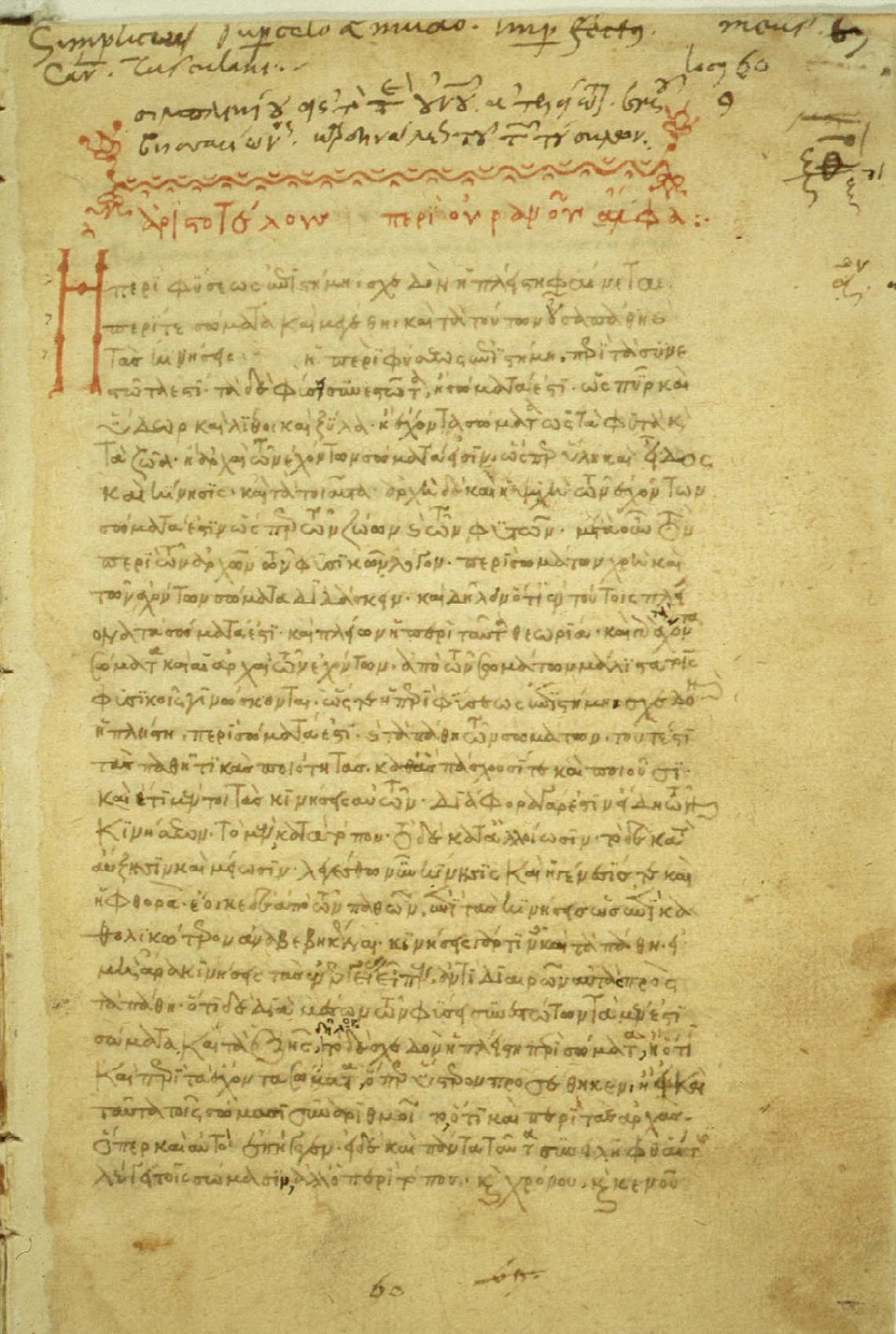
Simplicius of Cilicia
Greek · Philosophy · Commentary · Astronomy · Ethics
4 works · 170,594 aligned sentences
Birth: c. 480 AD / Death: c. 560 AD
Cilicia → Athens · philosopher · mathematician · astronomer
Commentary on Aristotle's Categories
This work is a comprehensive and monumental commentary by the late Neoplatonist philosopher Simplicius of Cilicia on Aristotle's foundational logical treatise, the Categories. Synthesizing a rich exegetical tradition that includes Porphyry, Iamblichus, and Boethius, Simplicius seeks to harmonize Platonic and Aristotelian philosophy while frequently integrating the Pythagorean doctrine attributed to Archytas. The opening sections meticulously examine the aims, authenticity, and title of Aristotle's treatise, establishing that its subject matter concerns simple expressions that signify sensible things through concepts. The main body of the work conducts an exhaustive analysis of the ten supreme genera, beginning with preparatory distinctions such as homonyms and synonyms, and proceeding through primary and secondary substance, quantity, relation, quality, action, passion, and the remaining categories, vigorously defending Aristotle against criticisms from Plotinus and the Stoics. In the concluding section on the Postpraedicamenta, Simplicius investigates the four modes of opposition, priority, simultaneity, motion, and the multiple meanings of having, demonstrating their necessity for confirming and judging the preceding categories. Serving as a culmination of the ancient commentary tradition, the treatise systematically bridges the logical order of the sensible world with the intelligible realm.
Philosophy283 chunks · §1.3-3.4–§438.1-438.3625,744 aligned sentencesRead →Commentary on Aristotle's On the Heavens
This work is an extensive commentary by Simplicius of Cilicia on the four books of Aristotle's foundational cosmological and physical treatise, On the Heavens (De Caelo). The commentary systematically examines the nature and motion of simple bodies across both the celestial and sublunary realms, establishing the eternity of the fifth element (aether) endowed with circular motion, the uniqueness and finitude of the cosmos, and the spherical Earth's immobility at the center. In the latter sections, Simplicius investigates the mutual transformation of the four sublunary elements (fire, air, water, earth) subject to generation and corruption, alongside the principles of heaviness and lightness governing their rectilinear natural motions toward their proper places. Throughout the text, he critically scrutinizes the interpretations of earlier commentators, most notably Alexander of Aphrodisias, while launching a vigorous philosophical refutation against his contemporary John Philoponus, who defended a Christian model of temporal creation and cosmic mortality. Moreover, Simplicius endeavors to harmonize Aristotle's natural philosophy with the cosmology of Plato's Timaeus, arguing for an underlying agreement between the two authorities. Integrating the rich geometric models of ancient astronomy, this monumental work articulates an eternal, orderly universe sustained by divine intellect and nature.
Philosophy492 chunks · §1.2-2.25–§730.28-731.2935,882 aligned sentencesRead →Commentary on Aristotle's On the Soul
This work is a comprehensive commentary on Aristotle's On the Soul (De Anima), systematically elucidating the nature of the soul, its distinct capacities, and its relation to the body. Simplicius opens by situating the study of the soul as an intermediary inquiry between physics and metaphysics, rigorously examining earlier philosophical doctrines to establish the soul's incorporeal essence. In commenting on Book II, he grounds his analysis in the definition of the soul as the first complete actuality (entelecheia) of a natural organic body potentially possessing life, tracing the hierarchy of life from vegetative functions to the five specialized senses and their media. Turning to Book III, he examines common sense and imagination (phantasia) before demonstrating the transcendence and immortality of the active intellect as distinct from mortal bodily faculties. The commentary culminates in an account of how desire and practical reason produce animal locomotion, concluding with a teleological explanation of why touch is indispensable for survival while the distant senses serve the creature's flourishing and well-being.
Philosophy274 chunks · §1.3-2.23–§328.18-329.3421,995 aligned sentencesRead →Commentary on Aristotle's Physics
This monumental work is an exhaustive commentary by the sixth-century Neoplatonist philosopher Simplicius on all eight books of Aristotle's Physics. Following the original text lemma by lemma, the author meticulously evaluates the interpretations of earlier commentators such as Alexander of Aphrodisias, Eudemus, and Porphyry, while vigorously refuting the contemporary Christian thinker John Philoponus, who argued for the temporal beginning of the cosmos. The first half of the work establishes the foundational framework of physics: Books I and II define natural principles—matter, form, and privation—alongside nature, the four causes, and teleology, after which Books III and IV scrutinize the definition of motion, the infinite, place, the impossibility of the void, and time. In the second half, Books V and VI investigate the classification of change, continuous magnitude, and the infinite divisibility of time and space, resolving Zeno's famous paradoxes; Books VII and VIII then rigorously demonstrate the eternity of motion and the axiom that everything in motion is moved by something. The treatise culminates in the demonstration of eternal and single circular motion, deriving the necessity of a first unmoved mover that is indivisible, without magnitude, and acts not only as a final cause but also as an efficient cause. Through this extensive analysis, the work shows how physical inquiry into motion inevitably ascends to the realm of first philosophy and transcendent divine causes.
Philosophy989 chunks · §1.3-2.26–§1365.6-1366.2286,973 aligned sentencesRead →