

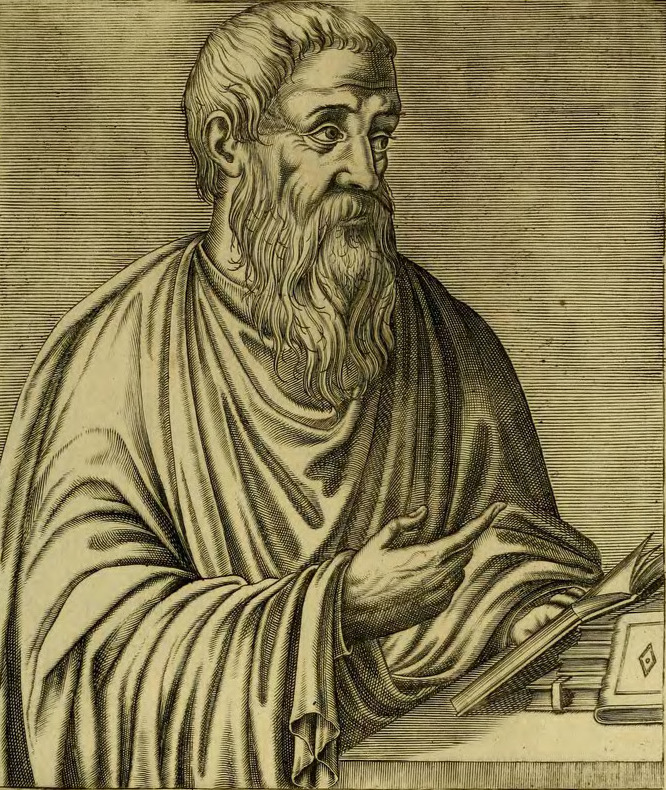
Alexander of Aphrodisias
Greek · Philosophy · Commentary
6 works · 147,521 aligned sentences
Commentary on Aristotle's Metaphysics
This work is a philosophical commentary in which Alexander of Aphrodisias examines and clarifies the fourteen books of Aristotle's *Metaphysics* through meticulous, lemma-by-lemma textual analysis. The commentary begins by grounding human desire for knowledge and defining wisdom (*sophia*) as the contemplation of first causes, evaluating earlier doctrines from the Presocratics to Plato and establishing the fourfold causality and the impossibility of an infinite regress of causes. It then systematically presents the philosophical puzzles (*aporiai*) confronting first philosophy, elaborating on 'being qua being,' the foundational status of the principles of non-contradiction and excluded middle, and the diverse meanings of philosophical terms. As the inquiry proceeds, Alexander analyzes sensible substance, the composite nature of matter and form, and the priority of actuality (*energeia*) over potentiality, while investigating the opposition between the one and the many. In its culmination, the commentary expounds the nature of the eternal, unmoved prime mover as pure intellect and supreme cause, while thoroughly refuting the Platonist and Pythagorean hypostatization of Forms and numbers, thereby reaffirming the unified and orderly structure of reality.
Philosophy660 chunks · §1.3-2.21–§835.21-837.1154,298 aligned sentencesRead →Commentary on Aristotle's Meteorology
This work is a comprehensive commentary by the ancient Peripatetic philosopher Alexander of Aphrodisias on Aristotle's four books of the Meteorology. Alexander systematically situates the treatise as a vital link connecting the cosmology of On the Heavens and On Coming-to-be and Ceasing-to-be with subsequent investigations into living beings. The first two books examine upper and lower atmospheric phenomena—such as meteors, comets, the Milky Way, precipitation, the salinity of the sea, winds, earthquakes, and thunder—grounding them in the dual exhalations (vaporous and smoky) and the celestial influence. The commentary then addresses the optical phenomena of Book 3, offering geometric demonstrations of halos and rainbows, before turning in Book 4 to the primary qualities (hot, cold, dry, moist) that govern concoction, solidification, and the properties of homoeomerous substances. Throughout, Alexander provides lucid physical and mathematical elucidations, establishing this text as an indispensable guide to the logical coherence of Aristotelian natural philosophy.
Philosophy155 chunks · §1.3-2.34–§225.31-227.2212,402 aligned sentencesRead →Commentary on Aristotle's On Sense
This work is a philosophical commentary in which Alexander of Aphrodisias meticulously explicates Aristotle's On Sense and the Sensible lemma by lemma. Building upon the foundational doctrines of De Anima, the commentary systematically investigates the nature of the sense organs and their objects as activities common to both soul and body. In the opening sections, Alexander examines the correlation between the sensory organs and the four elements, refuting earlier theories such as the visual emission models of Empedocles and Plato or the atomistic effluence theories of Democritus, while upholding the Aristotelian account of vision grounded in the medium's transparency. The central part explores the physical generation and finite species of proper sensibles—namely colors, flavors, and odors—demonstrating that perception arises from true mixture and qualitative alteration of the medium rather than the juxtaposition of imperceptible particles. The latter half addresses complex puzzles concerning the propagation of perception, showing that light actualizes the medium timelessly, and resolves the paradox of the infinite divisibility of sensible qualities by rejecting naturally imperceptible magnitudes or times. Finally, the work confronts the problem of simultaneous perception—how distinct sensibles like sweetness and whiteness can be apprehended at once—concluding that a single perceptual center, numerically one in its substrate but manifold in its defining capacities, accounts for this unified discrimination.
Philosophy95 chunks · §1.3-2.24–§171.23-173.128,110 aligned sentencesRead →Commentary on Aristotle's Prior Analytics Book 1
This work is a comprehensive commentary by Alexander of Aphrodisias on Book 1 of Aristotle's Prior Analytics, which laid the foundation of formal deductive logic. It opens by addressing whether logic is a 'part' or an 'instrument' of philosophy, before systematically establishing the definitions of terms, premises, and the essence of the syllogism, along with the rules of premise conversion. Alexander then methodically examines the three figures of categorical syllogisms, the intricate mechanics of modal syllogisms combining necessity and possibility, and the formal reduction of all imperfect syllogisms to the first figure. The work proceeds to develop the heuristic method for discovering middle terms to prove given theses, rejecting the Platonic method of division as non-demonstrative while providing detailed procedures for analyzing complex, everyday, or mathematical arguments into their canonical syllogistic figures. In its final sections, the commentary investigates oblique predication, the logical function of modifying determiners, and the critical distinction between simple negation and transposed affirmation. Throughout the text, Alexander rigorously defends and reconstructs the Aristotelian system against competing interpretations from early Peripatetics like Theophrastus and rival theories of the Stoics.
Philosophy316 chunks · §1.3-2.33–§417.17-418.2025,691 aligned sentencesRead →Commentary on Aristotle's Sophistical Refutations
This work is a philosophical commentary by Alexander of Aphrodisias on Aristotle's logical treatise Sophistical Refutations. Its central aim is to elucidate the mechanisms of apparent or deceptive arguments (sophisms) and to establish rigorous criteria distinguishing them from genuine refutations. In the first half, Alexander meticulously analyzes the thirteen modes of fallacious reasoning—divided into six dependent on language and seven independent of language—demonstrating how they all logically reduce to a failure in the proper definition of refutation (ignorance of refutation). The commentary then examines the tactics employed by sophists to force opponents into paradox, babbling, or solecism, clearly distinguishing contentious argumentation from philosophical dialectic and examination. In the latter half, practical and systematic methods of resolving these fallacies are presented, emphasizing the necessity of pinpointing direct logical defects rather than relying on superficial responses. Finally, Alexander explores the nature of 'sharp' arguments and the duty of respondents, concluding with a reflection on Aristotle's achievement in founding the systematic study of logical reasoning.
Philosophy145 chunks · §1.1-2.33–§197.15-198.1614,114 aligned sentencesRead →Commentary on Aristotle's Topics
This work is a comprehensive, passage-by-passage commentary by the Peripatetic commentator Alexander of Aphrodisias on Aristotle's logical treatise, the Topics. It aims to elucidate the complete system of dialectic as an art of reasoning and refutation based on reputable opinions (endoxa), in contrast to strict scientific demonstration that proceeds from necessary first principles. The opening section examines foundational concepts, including the definition and utility of dialectic for philosophical inquiry, the nature of deduction, the four predicables (genus, definition, property, and accident), and the basic instruments of dialectical inquiry. The central books (Books 2–7) systematically investigate an extensive catalogue of 'topoi' (argument schemes or commonplaces) used to establish or overturn propositions concerning each predicable as well as comparison and identity. Finally, Book 8 addresses the actual practice of dialectical disputation, detailing the strategies of both questioner and answerer, techniques for concealing one's intended conclusion, the management of induction and objections, and methods of intellectual training. By combining rigorous formal analysis with practical debate techniques, the commentary provides a thorough guide to the ancient Peripatetic theory and practice of dialectic.
Philosophy364 chunks · §1.3-3.12–§589.8-591.532,906 aligned sentencesRead →